
Infinity Rehab Blog

Student Mentorship: A Professional Therapist’s Take

June 19th, 2013

Why You Need a Student

Our country’s health care industry is dependent on an increasing workforce. Health sector employment is projected to grow from over 14 million jobs in 2010 to nearly 18.3therapist student million jobs in 2020, an increase of 30%. This compares to only 13% growth for jobs in all other employment sectors. Students of allied health professions provide a critical source of new health care employees. A successful clinical internship program can expedite the learning process for students becoming professional practitioners.
The goal of a clinical internship program is to provide students with an excellent learning experience while leveraging the clinical focus and resources of a company. At Infinity Rehab, we strive to offer as many clinical internships as possible to students seeking opportunities to work with older adults.
Over the past three years, Infinity has placed over 300 students in clinical rotations across three rehab disciplines in seven states. This commitment requires a significant investment of time and resources to coordinate and provide the supervision of these students. Clinicians practicing in the field must commit extensive time and attention to give students a fulfilling experience during a clinical rotation. Being involved in a student intern program sounds like a great idea, but is it worth the energy?

“Will you take a student?”

What a loaded question. For many seasoned therapists, those words invoke a first reaction of stress, self-doubt and maybe even personal insecurity. For a few, excitement and intrigue may come to mind.  Either way, it feels like added work. And added work is never good if it’s not worth the sacrifice.

studentConsider what the question implies:

  • It is a one-way road.  The question suggests a power imbalance. “I, Experienced Clinician, give to you, Young Novice, my knowledge. Now go be wise.”
  • It is a burden.  To some degree, there is an imposition on your day as a therapist.
  • It is your duty.  This is a commitment that you owe someone else. You were a student once – now it’s your turn.

The science of decision making says you are a more effective person when you can make a choice rather than be forced into a decision. A favorite practice of mine is to “reframe” a situation when I face a significant decision that lacks a clear benefit.

Reframing is a great tool and helps you be a stronger professional. The facts stay the same; it’s the view that changes. No person ever gets things exactly as they want. Successful people make the circumstances they are dealt work for them. We help our patients do this all day – “This hard work gets you back home” – but health care professionals are often unpracticed at reframing our own challenges.

In my last blog post, we discussed what it means to be a “professional” in today’s health care environment. If we reframe the idea of mentoring students, will a clearer view emerge?

Perspectives

Today’s professional is open, appealing, collaborative, and humble. It is an attractive worldview if you aspire to be a greater version of yourself. Mentoring students is a natural fit for professional growth.

The perspective of a professional: Mentoring a student is a win-win deal.

Students bring energy, new knowledge, and fresh perspective to the field – sometimes from their own university research experience. Time spent orienting and training students is not always a sunk cost either; reviewing the basics is often a needed refresher for a professional. And possibly most exciting, professional networks begin to expand quickly – among companies, universities and clinicians alike.

Infinity Rehab is committed to mentoring and teaching future professionals. Our business is stronger because of it, and our industry depends on it. Thank you, current professionals, for considering how students fit into your own professional growth. Our health care industry depends on you.

——————————————————————————————————————————————————

Derek Fenwick, PT, MBA, GCS is a physical therapist and board-certified geriatric clinical specialist. He develops leaders in healthcare as the Director of Professional Development for Infinity Rehab. Find him on LinkedIn and on Twitter @DerekFenwickPT.

Introducing: Derek Fenwick – Director of Professional Development

May 30th, 2013

derek fenwickHello, I’m Derek Fenwick, PT, MBA, GCS. I served as an Area Rehab Director for Infinity Rehab for the past 2.5 years. Now, I’m both excited and proud to say I’ll take on the role of Director of Professional Development

My mission in this new position is to begin the task of cultivating the ideas, feelings, and innovative visions of our professional staff to help turn those deep notions into tangible, forward-moving realities.

It’s no secret, the health care industry is highly dynamic and ever-evolving. Luckily, we already have a proactive strategy at Infinity Rehab, aimed squarely at taking on this challenge:

Invest in our people.  The rest will follow.

That sounds great, right? But what does it mean?  And – more importantly – what does that philosophy mean for our therapists; especially in today’s health care world?

The renowned researcher and writer Allison Fine, contributed a great article to Harvard Business Review summarizing where Infinity stands on the question: “What does it mean to be a ‘professional’ today?”

Pro Chart Fenwick


Infinity Rehab recognizes that we are nothing without our people. We believe it is important to develop our managers and clinicians to be the best at every level of service to our company.

Subscribe for future updates to the Infinity Blog about my adventures in Professional Development. It’s going to be a fun and eye-opening journey over the coming months and years. Here is what you can expect to find in my For Your Growth section:

•    Tips on leadership and management, boiled down and ready for immediate use in your job
•    News on Infinity’s initiatives and upcoming opportunities for you and your top colleagues
•    Stories about our employees, and the amazing work you do to lead our industry forward everyday

My passion is learning what makes you…you. Connect with me on LinkedIn or follow me on Twitter. Also, be sure to check out the Infinity Rehab Facebook Page for some interesting links to articles and things that are sure to make you smile. -Derek

Caregiver Educational Workshops: A Component to Patient Safety

May 15th, 2013

At Infinity Rehab, it is our mission to enhance the quality of life for every person we serve. Through the work that our therapists do, the ultimate goal is for patients to reach their highest level of function. We work closely with the patient’s physician on a plan of care and will implement various therapies to achieve a sustainable level of comfort and mobility, if applicable.

In the assisted living, skilled nursing, and transitional care settings we work in, it is important for us to educate other care professionals on how to work with that patients when being moved from the therapy gym back to the patient’s room, or the dining hall, or out to the courtyard to enjoy the warm sun.

Caregivers play a key role in helping individuals move about the facility grounds. It is important that our therapists educate caregivers on how to properly move patients. What’s more important is the patient does as much for him or her while moving, which decreases the stress on the caregiver, prevents the caregiver from potential injury, and empowers the patient to achieve a higher level of independence.

With all this in mind, our therapists will hold educational workshops for caregivers (see image) to present on a variety of safety and care topics. So, in addition to the plan of care specifically designed for each patient, caregivers can use this training to work toward transferring patients throughout the building while achieving safety for themselves and the person under their care.

caregiver workshop

CELEBRATE BETTER HEARING AND SPEECH MONTH THIS MAY WITH INFINITY REHAB AND ASHA

May 1st, 2013

ASHA LogoSince 1927, the American Speech-Language-Hearing Association has celebrated Better Hearing and Speech Month each May to raise public awareness of speech and language disorders that affect 14 million Americans.

Speech and language disorders can take many forms and can limit academic achievement, social adjustment, and career advancement. An individual may be born with a speech or language disorder, or it may be caused by accidental injury or illness.

“Fortunately, most people with speech and language problems can be helped,” says Stacey Turner, MS, CCC-SLP, Regional Vice President of Operations for Infinity Rehab. “Even if the problem cannot be eliminated, we can teach people with speech and language problems strategies to help them cope. People may not fully regain their capacity to speak and understand, but a speech-language pathologist can help them live more independently.”

Speech-language pathologists are the professionals who treat all types of speech, language, and related disorders. They hold at least a master’s degree and are certified by the American Speech-Language-Hearing Association. Speech-language pathologists work in schools, private practice, hospitals, clinics, and other InfinityRehabNewhealth and education settings.

Infinity Rehab is a leading provider of clinically intensive, comprehensive physical, occupational and speech therapy in the sub-acute and long-term care environments. Founded and led by a team of therapists, it serves patients in skilled nursing facilities and outpatient settings in assisted living and independent living communities for over 170 facilities across nine states. Based in Wilsonville, Oregon, Infinity Rehab is a leading choice for contract therapy management services in the Pacific Northwest, Mountain, and Midwest regions.

The American Speech-Language-Hearing Association (ASHA) is the national professional, scientific and credentialing association for more than 145,000 audiologists, speech-language pathologists and speech, language, and hearing scientists.

Occupational Therapy Helps Individuals Live Life to Its Fullest!

April 5th, 2013

It is the mission of Infinity Rehab to enhance the life of every person we serve. We achieve this through the therapy services we offer to our clients every day – Physical Therapy, Speech Therapy, and Occupational Therapy. April is the month when we, as an industry, recognize all of our Occupational Therapists and Occupational Therapy Assistants for their dedication, hard work, and impact they have on patients across a range of clinical settings.

Occupational Therapists and Occupational Therapy Assistants help people across the lifespan participate in the things they want and need to do through the therapeutic use of everyday activities (occupations). Common occupational therapy interventions include helping children with disabilities to participate fully in school and social situations, helping people recovering from injury to regain skills, and providing supports for older adults experiencing physical and cognitive changes.

Occupational therapy services may include comprehensive evaluations of the client’s home and other environments (e.g., workplace, school), recommendations for adaptive equipment and training in its use, and guidance and education for family members and caregivers. Occupational therapy practitioners have a holistic perspective, in which the focus is on adapting the environment to fit the person, and the person is an integral part of the therapy team.

Stay tuned to this blog and the Infinity Rehab Facebook page (www.facebook.com/InfinityRehabCommunity) throughout April to learn more about the great things our amazing Occupational Therapists and Occupational Therapy Assistants are capable of.

Infinity Rehab VP Appointed NARA Western Regional Coordinator

March 22nd, 2013
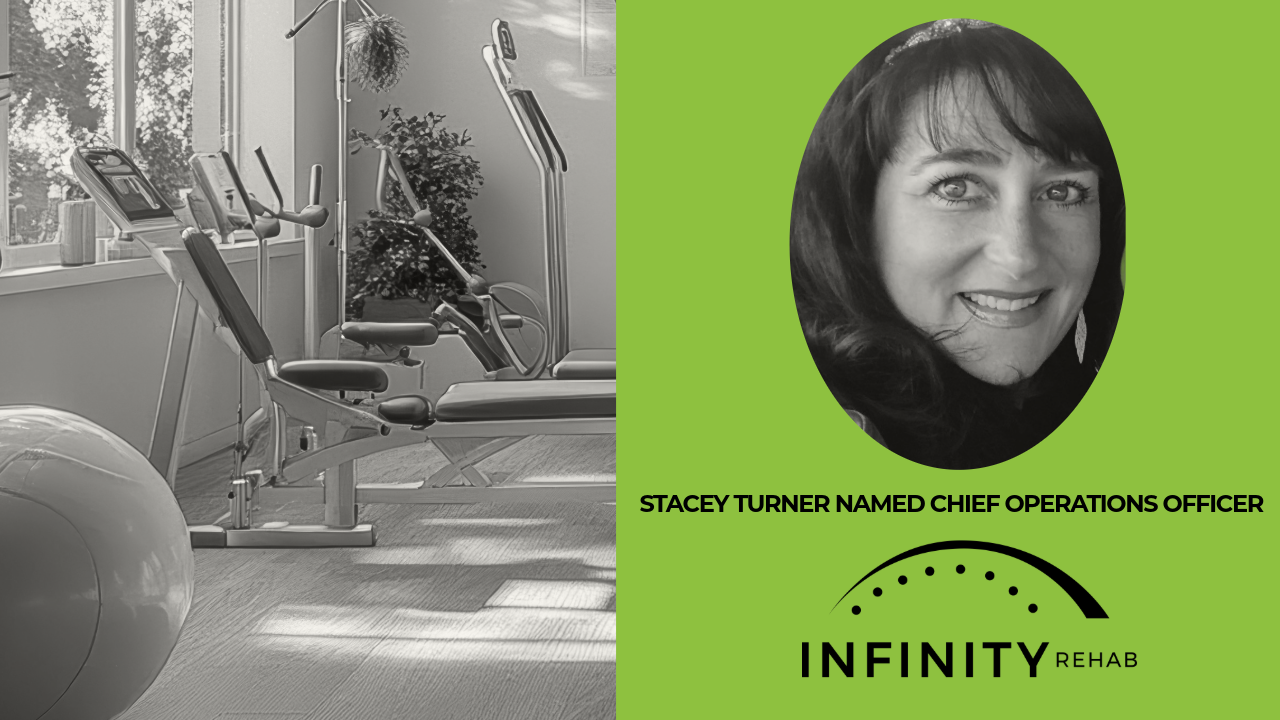
Stacey Turner, MS, CCC-SLP, Vice President of Operations

Stacey Turner, MS, CCC-SLP, Vice President of Operations

Stacey Turner, MS, CCC-SLP, Regional Vice President of Operations, was recently appointed as the Western Regional Coordinator for the National Association of Rehabilitation Providers and Agencies (NARA). In this capacity, Turner is tasked with providing knowledge, support, and resources to new association members – with the goal of fostering unity amongst new members. “NARA is committed to providing solutions in an ever-changing healthcare environment as well as sharing best practices.” says Turner. “I believe in the mission and values of NARA and I am honored  to be selected and serve in this role.”

Since joining Infinity Rehab in 2002 as an Area Rehab Director for the Southern Oregon region, Stacey has enjoyed being an integral part in the continued growth and success of the company. In 2004, she assisted with opening our Midwest region. In 2005, she transitioned back to the Northwest as Regional Director of Operations for Washington, Idaho and Alaska. In July 2010, she returned to Oregon as Regional Director of Operations for Oregon, Colorado, Utah and Southern Idaho and in January of 2012, moved into the position of VP of Operations. Born and raised in St. Louis, Missouri, Stacey earned a Bachelor of Science degree in Communication Disorders and Psychology at Southwest Missouri State University followed by a Master’s Degree in Speech Pathology at Fontbonne College in St. Louis. Stacey has worked as a Speech Language Pathologist and Rehabilitation Leader in a variety of clinical settings including skilled nursing, home health, outpatient, TBI sub-acute, acute care and inpatient rehab. Stacey is proud to be a part of Infinity Rehab, a culture based in trust and caring. “There is nothing more rewarding than being part of a great team.”

The National Association of Rehabilitation Providers and Agencies (NARA) was founded in 1978, and functions as a trade association nara-logorepresenting the interests of a membership base spanning across the nation.  NARA’s membership is open to rehab therapy organizations and those who provide support to therapy providers.  Current membership represents rehab businesses consisting of over 15,000 healthcare professionals dedicated to providing a multitude of skilled rehabilitation therapy services to individuals in a variety of settings including inpatient, outpatient, skilled care, assisted living, educational systems, industry / occupational health.

6 Simple Exercise Tips for a Heart-Healthy Life

February 22nd, 2013

Greetings,

February is officially American Heart Month.  This is an opportunity to educate our families, friends, patients, and communities on how to live heart-healthyamericanheartmonth lives and how to battle cardiovascular disease.  Heart disease, including stroke, is the leading cause of death for men and women in the United States, claiming more than 865,00 American lives each year.

The good news is that as therapists we have in our power the ability to prescribe the most powerful medication in existence to fight cardiovascular disease:  Exercise.  If exercise could be reduced to a pill, it would become the most prescribed medication in history.  The not-so-good news is that we don’t always self-prescribe this powerful intervention in our own lives.

Here’s what the evidence shows:  150 minutes per week of moderate intensity exercise is required to maintain a healthy cardiovascular system (in addition to proper diet and weight management).  This is a minimum requirement as 300 minutes per week result in even greater health benefits.  It’s also recommended that resistance training be included 2-3 days per week.  As therapists, we also know that the intensity of exercise can be manipulated higher or lower thereby changing the number of minutes per week of exercise required (higher intensity = less minutes required).

The number one barrier to meeting our exercise goals is always, “not enough time.”  We all lead busy lives and sometimes life just gets in the way.  My job often requires me to be on early morning conference calls and late meetings and dinner engagements with clients.  I also have to travel a great deal for business.  In addition, like many of you, I have children that seem to have constant transportation needs going from activity to activity.  All of this has the potential to derail my good exercise intentions.  I would like to share a few strategies I have developed and use in my life to overcome some of the common barriers to regular exercise.

1.    Multiple exercise options:  I eliminate the potential excuses of not exercising by creating multiple possible opportunities.  For example, I have a treadmill and stationary bicycle in my garage that I can use if the weather is not cooperating for a run or bike ride (which is often in Portland, OR).  I also have a gym membership that includes access to gyms throughout my region.  I have some dumbbell weights and exercise bands at home for resistance training.  I can also use my wife’s exercise videos, including Yoga, for variety.
2.    “Something is better than nothing:”  My personal motto is that some exercise on any given day is better than none at all.
3.    Prioritize exercise in your schedule:  I plan each of my weeks in advance.  The first event I schedule into each of my days is exercise.  This may require a 5:00 AM ride on my stationary bike in the garage or session at the gym or an evening exercise session.  When I travel out of town, the first items I pack in my suitcase are workout clothes and running shoes.  Most hotels these days have at least a small workout room with treadmill and weights.  I also really enjoy early morning runs in cities I do not get to visit very often.  It’s a great way to get to know them.  If neither of these options is available, I’ve been known to run the stairs repeatedly in the hotel and do sit-ups and push-ups in my room.
4.    Incorporate exercise into your daily routine:  I try to commute to the Infinity office by bicycle 2-3 days each week.  I do this year round.  It takes a bit more planning, but it allows me to get close to 2 hours of exercise (50-60 minutes each direction) without having to actually schedule an “exercise session” into my schedule.  I would have spent most of this time sitting in my car in traffic anyway.  It’s a much more efficient use of my time.  Similar opportunities include always using the stairs instead of escalators and elevators, taking a walk at lunch, or parking farther from the entrance of a building.  My job doesn’t have the benefit of being on my feet all day treating patients, so I have converted my desk to a treadmill desk.  If your job requires you to sit most of the day, be sure to at least take frequent standing/walking breaks.
5.    “There is no such thing as bad weather – only bad gear:”  If you live in the Pacific Northwest or a climate with extreme weather conditions, you learn that weather does not have to be a deal breaker for exercising outdoors.  Rain?  Use fenders on your bike and where a rain shell and rain pants.  Dark?  Run with a headlight and mount front and rear lights on your bike.  Also, wear reflective gear.  Cold?  Layer!  In my opinion, there is no better fabric than wool.  I layer wool and remove layers as I warm up.  Snow?  Knobby mountain bike-type tires work well in the snow.  I also have traction devices that I attach to the outside of my running shoes that allow me to run in ice and snow.  Extreme heat?  Go on early-early morning runs or rides before the temperature climbs.
6.    Motivation:  I have found it motivational to sign up for a running or cycling event.  Once you pay for the event and put it on your calendar, it serves as a constant reminder that you have this particular event for which to prepare.  Even better – sign up with a buddy and train together.  You are less likely to skip a training session if you know you will be letting down your friend.

I would love to hear your exercise strategies! Email them to me: mbillings@infinityrehab.com

Finally, I came across a TED Talk that I think is worth viewing.  “Inactivity is a major cause of death!”  Enjoy!

Warm regards,

Mike Billings

Infinity Rehab Re-Approved as ASHA Continuing Education Provider

January 16th, 2013

January 9, 2013 –  The Continuing Education Board (CEB) of the American Speech-Language-Hearing Association (ASHA) recognized Infinity Rehab on ASHA CE LogoJanuary 9, 2013 by re-approving them for an additional five years as an ASHA Approved Continuing Education (CE) Provider.  ASHA Approved CE Providers are approved to offer ASHA Continuing Education Units (CEUs) for the courses they offer to audiologists and speech-language pathologists.  The recognition period extends for five years and includes all courses offered during that time that meet the ASHA CEB standards.

“We are pleased to welcome Infinity Rehab as our newest ASHA Approved CE Provider organization,” stated Dr. Patricia Prelock, president of ASHA and dean of the College of Nursing and Health Sciences, University of Vermont.  Prelock added “Infinity Rehab is part of the 525 organizations in the United States and internationally that have had their organizational process and courses reviewed by our experts in continuing education to ensure the highest possible standards are met.”

In order to achieve ASHA Approved CE Provider status, Infinity Rehab completed a rigorous application process and successfully demonstrated adherence to the ASHA Continuing Education Board standards that focus on the design, development, administration, and evaluation of its continuing education courses offered for audiologists and speech-language pathologists.  The re-approval process involved the review of all courses offered by Infinity Rehab in the past five year period and their on-going adherence to ASHA CEB standards.  As a result of re-approval, Infinity Rehab agreed to continue their compliance with ASHA CEB standards and can continue to promote their organization and courses using the ASHA CE logo on promotional course material.  In addition, Infinity Rehab is listed on the ASHA CEB’s Approved CE Provider list and their courses that meet CEB standards appear in the ASHA CE Course Search on the ASHA website.

About Infinity Rehab

Infinity Rehab is a leading provider of clinically intensive, comprehensive physical, occupational and speech therapy in the sub-acute and long-term care environment.

The company was founded and is led by a team of therapists. It serves patients in skilled nursing facilities, schools and outpatient settings in continuing care communities, free-standing assisted living and retirement living facilities in more than 180 facilities in eight states.

About the American Speech-Language-Hearing Association (ASHA)

ASHA is the national professional, scientific, and credentialing association for more than 145,481 audiologists, speech-language pathologists, and speech, language, and hearing scientists. Audiologists specialize in preventing and assessing hearing and balance disorders as well as providing audiologic treatment including hearing aids. Speech-language pathologists identify, assess, and treat speech and language problems including swallowing disorders.

About the American Speech-Language-Hearing Association (ASHA) Continuing Education Board (CEB)

The ASHA CEB supports and facilitates professional development by assisting individuals in the management of lifelong learning; encouraging the availability of quality, relevant CE opportunities through its network of ASHA Approved Continuing Education Providers; and recognizing individual accomplishments in CE with the ASHA Award for Continuing Education (ACE).

Role of Therapy Professional in Person Directed Care – Eden Alternative

January 9th, 2013

The Eden Alternative is a small not-for-profit organization that supports the Culture Change movement in various settings that are homes to elders. It is based on the core belief that aging should be a continued stage of development and growth rather than a period of decline. Since 2009, Tyler Keeter, PT, DPT, a Certified Eden Associate and Area Rehab Director for Infinity Rehab, has worked to integrate Eden’s principles into Infinity’s therapy operations. The work has led to various principles and trainings for Skilled Nursing Facility therapists, most of which are detailed in Eden’s recently published “Role of Therapy Professional in Person Directed Care” packet, in which Dr. Keeter was an author. “This packet should assist therapy professionals in the journey towards a more person-directed approach. It outlines the basic systems and processes which help support such a culture in the therapy department, and goes on to review specific clinical approaches that may be utilized with clients and residents. I am happy to report that this sort of approach has been found to improve individual clinical outcomes, departmental financial outcomes, resident satisfaction, and therapist happiness in our departments and in the scientific literature, (1)” says Dr. Keeter.

Here is the link to the packet:  http://www.edenalt.org/paradigm-busters/role-of-therapy-professional-in-person-directed-care

The Eden Principles
  1. The three plagues of loneliness, helplessness and boredom account for the bulk of suffering among our Elders.
  2. An Elder-centered community commits to creating a Human Habitat where life revolves around close and continuing contact with plants, animals and children. It is these relationships that provide the young and old alike with a pathway to a life worth living.
  3. Loving companionship is the antidote to loneliness. Elders deserve easy access to human and animal companionship.
  4. An Elder-centered community creates the opportunity to give as well as receive care. This is the antidote to helplessness.
  5. An Elder-centered community imbues daily life with variety and spontaneity by creating an environment in which unexpected and unpredictable interactions and happenings can take place. This is the antidote to boredom.
  6. Meaningless activity corrodes the human spirit. The opportunity to do things that we find meaningful is essential to human health.
  7. Medical treatment should be the servant of genuine human caring, never its master.
  8. An Elder-centered community honors its Elders by de-emphasizing top-down bureaucratic authority, seeking instead to place the maximum possible decision-making authority into the hands of the Elders or into the hands of those closest to them.
  9. Creating an Elder-centered community is a never-ending process. Human growth must never be separated from human life.
  10. Wise leadership is the lifeblood of any struggle against the three plagues. For it, there can be no substitute.


1.    Lenze EJ et al. Enhanced medical rehabilitation increases therapy intensity and engagement and improves functional outcomes in post-acute rehabilitation of older adults: a randomized-controlled trial. Journal American Medical Directors Association. 2012 Oct;13(8):708-12

From the President’s Desk: 2012 Year in Review

January 7th, 2013

2012:  Year in Review 

2011 ended in a flurry of Medicare and other regulatory changes that posed many challenges to rehab companies and created a lot of uncertainty heading into 2012.  Because of the efforts of Infinity Rehab’s therapists, leadership team and home office staff, 2012 was a very successful year for the company.  Infinity Rehab was able to accomplish some amazing things.

Clinical Outcomes

There were countless patient outcome success stories as evidenced by the numerous letters from patients, family members, customers, and peers received on a weekly basis as well as newspaper and television coverage of many programs.  Infinity therapists provided 1.2 million treatment visits – an all-time company record.

Patient Satisfaction Surveys

94% of patients surveyed after discharge said they “Would recommend an Infinity therapy department to a friend.”  Our goal for 2012 was 93%.

Award for Innovation

Infinity Rehab was the recipient of the Award for Innovation from the National Association of Rehabilitation Providers and Agencies for our work with telehealth in Washington State.  To our knowledge, Infinity Rehab is the only contract rehab company in the country utilizing this technology to ensure compliance and quality of care in the SNF setting.

Growth

Infinity Rehab’s business development team had a successful year bringing on 39 new contracts.  We now operate 166 contracts in nine states.

Recruitment

The recruitment department was extremely busy keeping up with the growth of the company and hired 923 new therapists.  Infinity now employs a total of 1,829 therapists, including full-time, part-time, and on-call.

Employee Satisfaction

The employee satisfaction survey revealed a 98.3% positive response to “Would recommend Infinity Rehab to a friend.” Our target was 97%.

Therapy Solutions

Therapy Solutions, the temporary staffing division of Infinity Rehab, made a lot of changes in 2012, including moving their headquarters from Seattle, WA to Wilsonville, OR, and had a very successful year.  They provided travel assignments for many therapists at multiple sites around the country and now staff on a regular basis many schools, SNFs, and hospitals.  Therapy Solutions anticipates further growth in 2013.

______________________________________________________

2013:  Looking Forward

Like the start of 2012, 2013 is starting under the same storm of regulatory and reimbursement challenges.  This again will present uncertainties for rehab companies, but Infinity Rehab is up to the challenge.  Here are a few of our focus areas:

EMPLOYEE SATISFACTION

We have designed many initiatives this year to further enhance employee engagement in the organization and improve company transparency, including revised training programs for our Directors of Rehab and more professional growth mentoring for all therapists.

GREAT QUALITY & CLINICAL OUTCOMES

One of our goals is to implement new functional outcome systems for all inpatient and outpatient sites.  We currently track functional outcomes, but this will give us even better tools for tracking the data hospitals and Accountable Care Organizations (ACOs) will require.

SUSTAINING A STRONG, HEALTHY COMPANY

We experienced strong growth in 2012 and expect the same in 2013.

Healthcare is moving towards a model that will require healthcare companies to serve more patients, at less cost to the system, while achieving even better clinical outcomes.
2013 is likely to bring more challenges as the US Congress addresses deficit reduction and controlling Medicare and Medicaid costs.  However, Infinity Rehab is well positioned for 2013 and poised for another successful year.

Regards,

Mike Billings, PT, MS, CEEAA
President


Contact Us    
25117 SW Parkway, Suite D
Wilsonville, OR 97070
(888) 75-REHAB or
503-570-3665
Infinity Rehab Blog  
Please visit our blog to see our most recent news and updates.
2013 Symposium  
Click here to register for the 2013 SW Symposium, June 29, 2013 in Tempe, Arizona.